Across Asia Assist Indonesia is now HealthMetrics Indonesia 🎉
Read the Press Release
The latest guide highlights private hospital procedure costs. Is your organisation ready to fund employee treatments?

The concept of rising private healthcare costs is no longer foreign to us. The past few years have seen hikes in the price of treatments and services, affecting insurance premiums as well. A 16% inflation of healthcare costs is projected for the year 2026. As private hospital costs are not highly regulated, many set their own fees apart from doctors’ consultation rates, specialist fees and medication.
While Malaysians of the middle-to-high-income prefer private healthcare, not all can afford it these days. Many Malaysians have been feeling the financial strain from high private bills. Reportedly, some bills have not shown clear pricing upfront. Many patients do not scrutinise the items on the bill, relying on insurance to pay their bills. They don’t realise that even a medical glove would be marked up 4 times the price!
In efforts to encourage transparency and accountability of private hospitals, Life Insurance Association of Malaysia (LIAM) had prepared a report on the price ranges for 26 common medical procedures in Malaysia’s private hospitals as a guide for the public.
In short, would you or (more specifically) your insurance coverage be able to cover the costs of procedures under Malaysian private hospitals?
Disclaimer: This report is based on claims reported from 1 January to 31 December 2024, as submitted by Malaysian Insurers and Takaful Operators. The typical bill amounts are represented by the median bill amount. These amounts cannot be taken as fixed fees as actual costs depend on the patient’s condition.
Circulatory
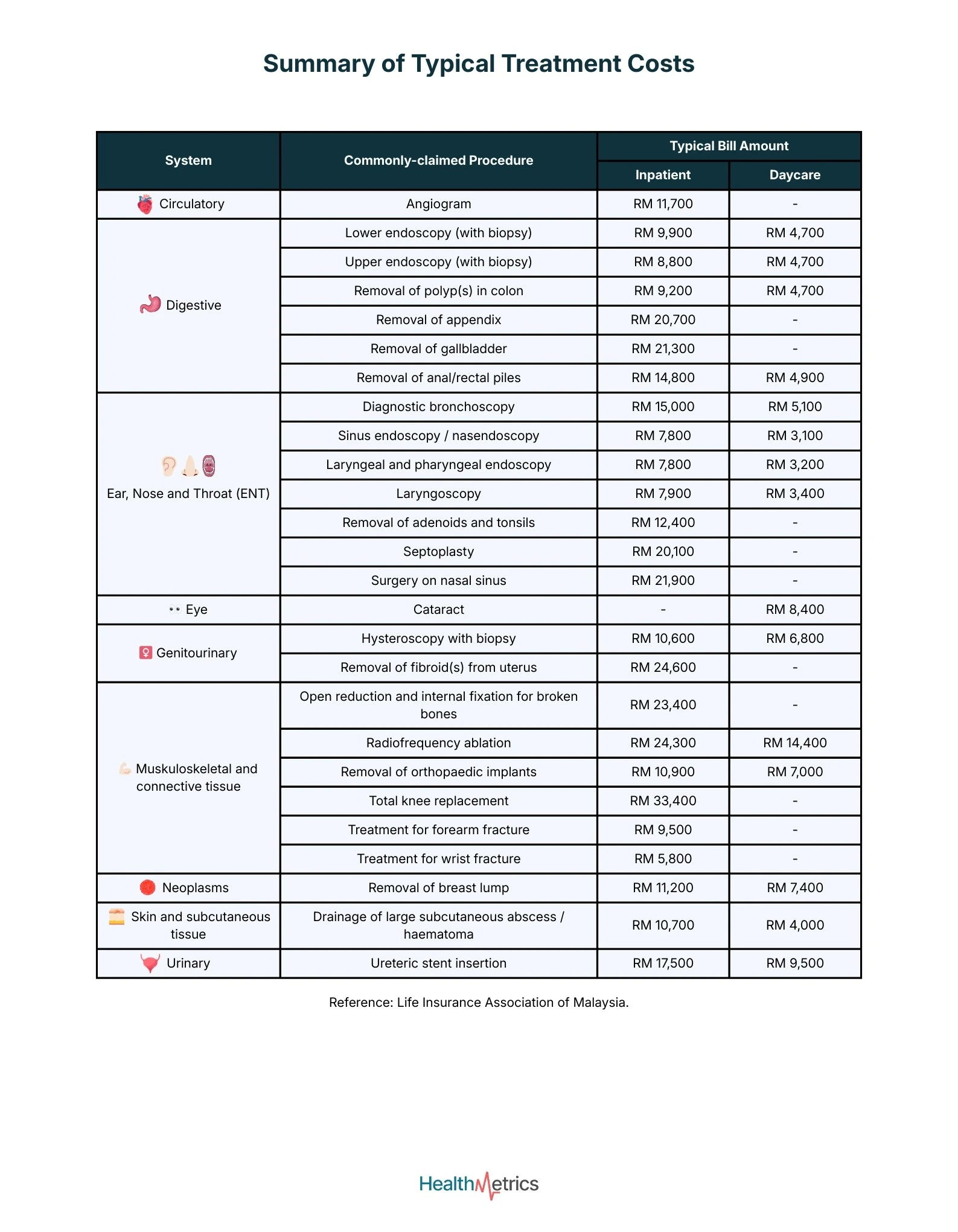
The typical procedure under this category is an angiogram (coronary arteriography and catherisation), for checking blockages in blood vessels. Inpatient bills for this normally range between RM8,800-18,300, where patients are typically charged RM11,700.
Digestive
There are several common procedures under the digestive system, including endoscopy (lower and upper) with biopsy, as well as removal of polyp(s) in colon, appendix, gallbladder, and anal/rectal piles. The typical bill amounts as follows:
Ear, Nose and Throat (ENT)
Under this category, common procedures include diagnostic bronchoscopy (examining lungs and airways), sinus endoscopy/nasendoscopy, laryngeal and pharyngeal endoscopy (examining throat with biopsy), laryngoscopy (examining voice box with/without biopsy), removal of adenoids and tonsils, septoplasty, and surgery on nasal sinus. The typical bill amounts as follows:
Eye
The most common procedure is cataract surgery, where the eye’s cloudy natural lens is surgically removed. In some cases, an artificial intraocular lens is implanted. Downtime is minimal, and patients are discharged on the same day. The procedure typically costs RM8,400.
Genitourinary
Also known as the urogenital system (grouped urinary and reproductive systems), the most claimed procedures are the hysteroscopy with biopsy (and possible removal of tissue or polyps), and removal of fibroid(s) from the uterus. The typical bills amount to:
Muskuloskeletal and connective tissue
Open reduction and internal fixation for broken bones, radiofrequency ablation, removal of orthopaedic implants, total knee replacement, and treatment for forearm and wrist fractures are the main procedures under this category.
Neoplasms
Neoplasms are an abnormal growth of tissue or tumours that can be benign or cancerous. A common procedure in private hospitals in Malaysia is removal of breast lump. Typically, the procedure costs RM11,200 for inpatient, and RM7,400 for daycare.
Skin and subcutaneous tissue
Often, drainage of large subcutaneous abscess/haematoma or deep infected wounds falls under this category. Typically, the procedure costs RM10,700 for inpatient, and RM4,000 for daycare.
Urinary
Under this category, the most typical procedure is the ureteric stent insertion. According to the claims reported, the typical bill amounted to RM17,500 for inpatient, and RM9,500 for daycare.
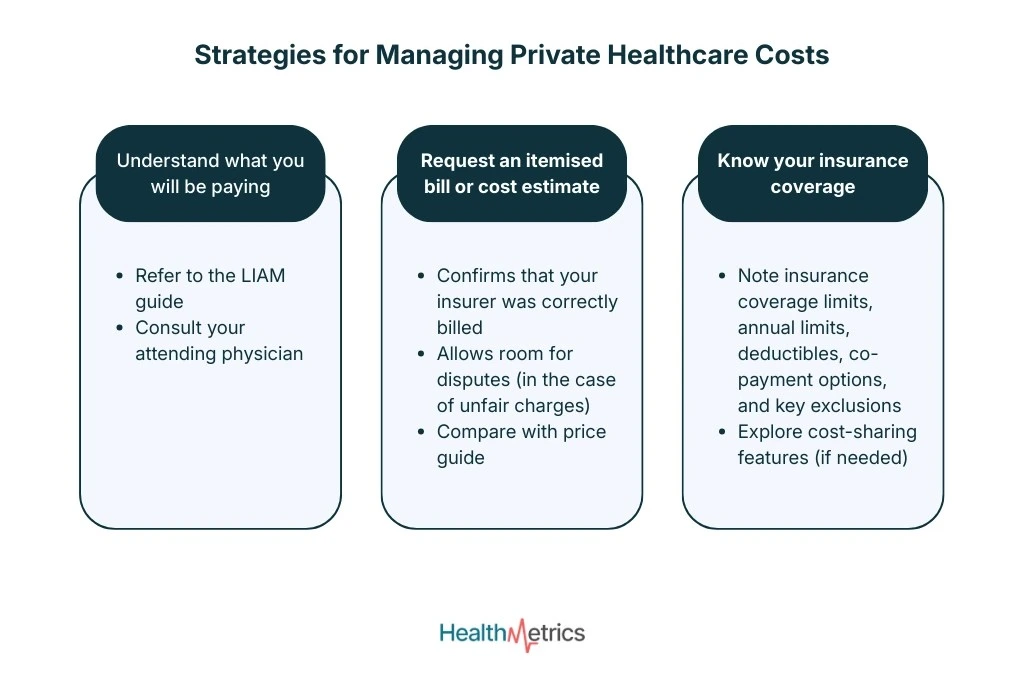
We might not have direct controls over the costs of procedures, but one thing we can do is to be smarter, better-informed patients.
Understand what you’re likely to pay (as shared above!)
The very reason LIAM released the price guide is that people like you and I can plan and be aware of charges for procedures. For more in-depth review of the price ranges, you can refer to the guide here.
You can also consult your attending physician to understand treatment options and estimated costs.
If caught in an emergency, however, you might not be able to research and survey. You and/or your loved ones can do this next thing.
Request an itemised bill
Even if your insurer is paying the bill directly, it helps to be informed about what was paid out. It helps confirm that your insurer was correctly billed as well and allows you room for disputes (in the case of unfair charges).
If you get the chance, you may ask for a cost estimate with breakdown before a procedure or admission. This gives you the chance to compare with the price guide, and/or ask about unusual charges.
Know your insurance coverage
It is important to note your insurance coverage limits, annual limits, deductibles, co-payment options, and key exclusions, especially knowing you’re paying recurring premiums.
Is your coverage sufficient for your procedure? Would you need any top-ups? Alternatively, you could also explore cost-sharing features made available by your insurer.
Regardless, you would be able to have a better gauge of your entitlements and eligibility of claims.
All in all, we ought to seek clarity in our private hospital bills and be able to gauge the cost of such services and treatments. As individuals, we are entitled to consumer rights when undertaking procedures with private hospitals. It is also to ensure that our insurance premiums are covering our needs sufficiently.
As HR professionals, it helps to know what your fellow colleagues are claiming and that they are educated on their entitlements as well. This helps you spot the roots of overspending (if any), or possibly fraudulent claims. This not only applies to private hospital bills, but general practitioner bills too. If you’ve not yet, consider reviewing your employees’ claims.
In a landscape where healthcare costs can fluctuate wildly, informed patients and organisations aren’t just better prepared. They’re better protected.

HealthMetrics is a unified digital TPA platform designed to streamline healthcare administration for insurers and corporates across Southeast Asia. It connects you to a regional healthcare network, automates claims and benefit management, and delivers real-time insights to optimise cost, care, and experience.
Whether you’re managing members at scale or navigating complex cross-border care, HealthMetrics empowers you with smarter tools and a seamless ecosystem.
Explore the HealthMetrics Platform or connect with our team to learn how we’re transforming healthcare access.
48 hours saved in benefit reimbursement.
HealthMetrics’ data-driven approach has been able to accelerate the processing of employee's health benefits significantly.
Read study >
85% reduction in administrative task
Companies can reduce up to 85% of time spent on HR administrative task and this frees up time for HR on more important tasks.
Read study >
Our pricing plans vary in terms of the features and services that are included, so you can select the one that offers the right mix of benefits for your specific requirements. Whether you are a small business owner, a freelancer, or a larger organisation, we have a pricing plan that is tailored to your needs.
You can view the details of each pricing plan on our website, and our customer support team is always available to answer any questions you may have and help you choose the right one for you.
Reach out to our 24/7 customer support through multiple channels.