The Real Cost of Presenteeism in Malaysian Workplaces
Presenteeism costs more to organisations than absenteeism - discover who's most affected, what it looks like early-on and what you can do about it.
Article by:
Ariel Cheah

Presenteeism costs more to organisations than absenteeism - discover who's most affected, what it looks like early-on and what you can do about it.

Malaysian employers would often have to pay for poor employee health through medical claims. But another reason for poor-health-related payments that often goes unnoticed is the lack of daily productivity.
Absenteeism is easy to spot - someone's out, and a line appears on a report. Presenteeism is the opposite. Though an employee is at their desk, logged in, they may be working at a fraction of their normal output because of illness, poor sleep, chronic stress, or an untreated health condition. It doesn't show up on any leave register. It presents itself in missed deadlines, slower service, and increased errors.
Based on a 2019 survey by AIA Vitality Malaysia, Malaysian organisations lose an estimated RM1.46 million a month due to absenteeism and presenteeism, amounting to around 73.3 productivity-days lost per employee yearly. That's not a rounding error in a wellness budget; it's a recurring, unbudgeted strain on output.
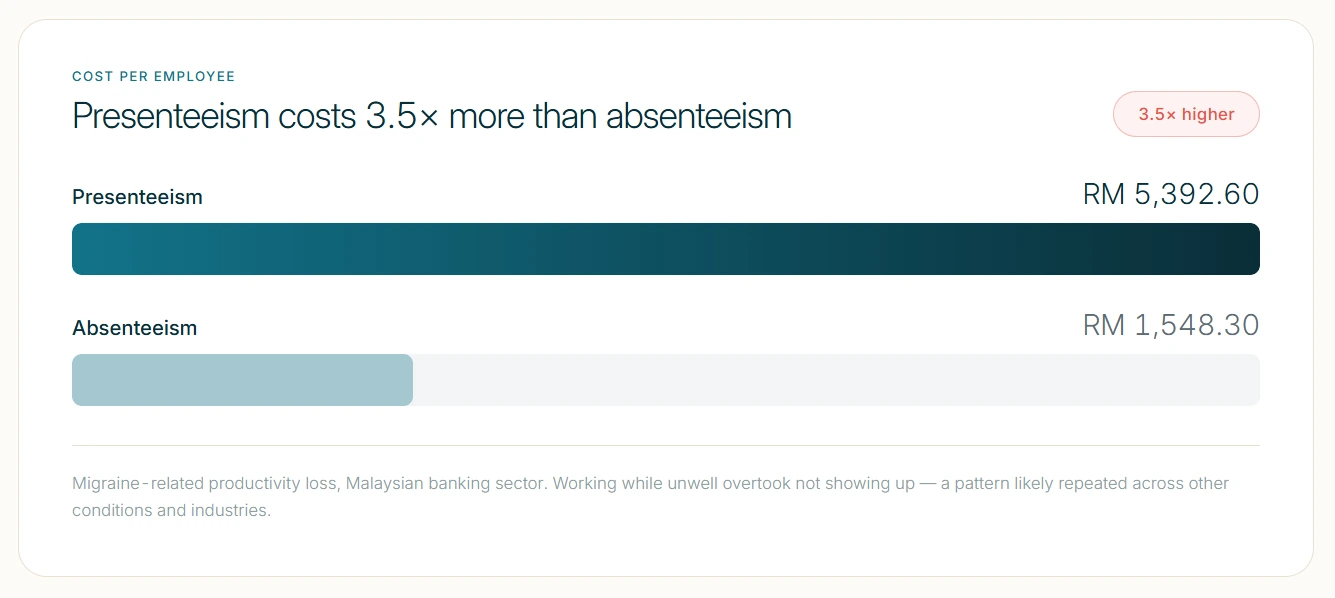
Presenteeism is the more glaring problem. A study was conducted on the impact of migraines on productivity and monetary loss among employees in Malaysian banking sectors. It was found that presenteeism cost employers RM5,392.60 per employee, compared with RM1,548.30 for absenteeism — about 3.5 times higher (Wong et al., The Journal of Headache and Pain, 2020). It seemed the "working while unwell" cost overtook the "not showing up" cost, signalling a pattern that likely occurs across other conditions and industries.
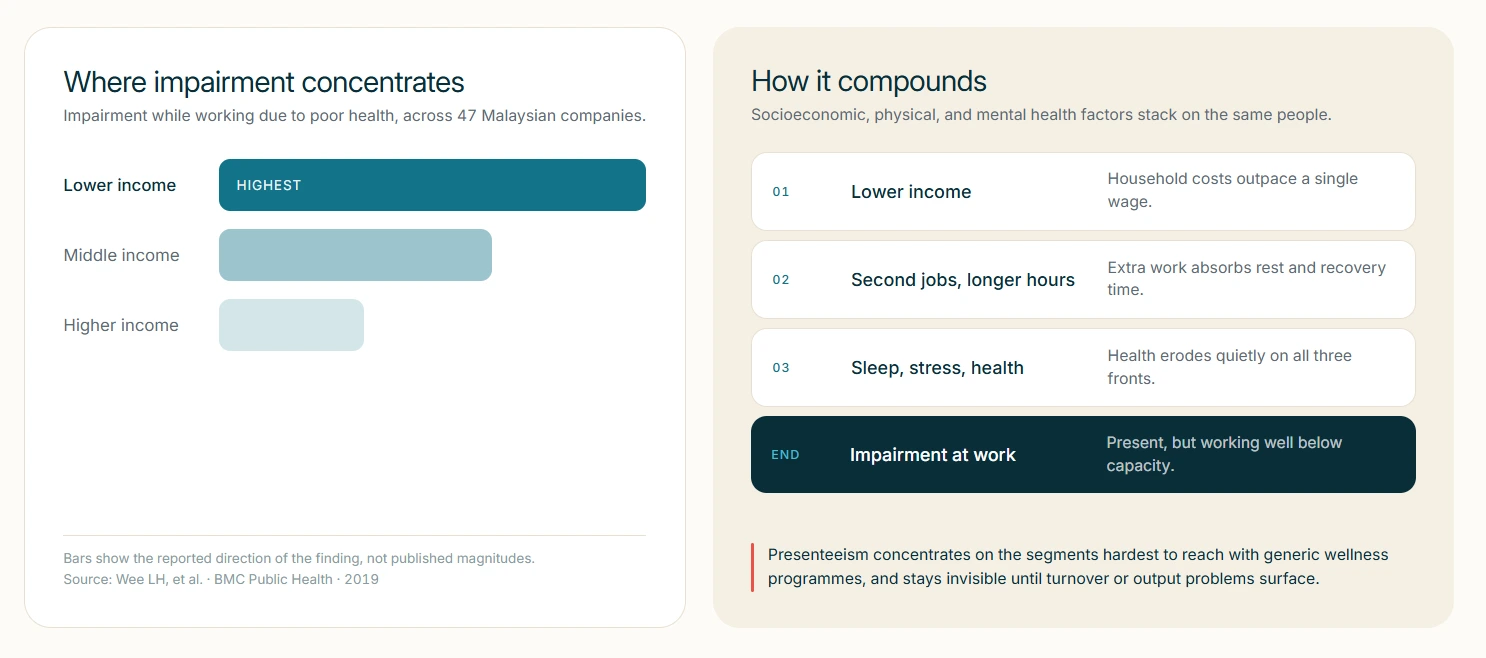
In a separate study across 47 Malaysian companies, results showed that impairment while working due to poor health was highest among lower-income staff (Wee LH, et al., BMC Public Health, 2019). It concluded that the key drivers behind absenteeism and presenteeism were a combination of socioeconomic, physical, and mental health factors. Those with lower income may seek out second jobs or work longer hours, affecting their sleep, stress levels, and physical health.
In other words, presenteeism is not randomly distributed, but concentrates on segments of the workforce that are hardest to support through generic wellness programmes. They are often easily overlooked until turnover or output problems arise.
Today's employee mental health strain is well-documented. However, most Malaysian organisations still struggle to connect that strain to actual productivity loss. Especially so if presenteeism easily goes unnoticed and never appears on a balance sheet.
The only trail presenteeism leaves is in the benefits data, such as claims patterns, GP visit frequency, prescription trends, and utilisation spikes. The standalone data may look unremarkable; but read together, they tell a very different story about which teams, roles, or conditions are quietly costing the most.
This is where TPA-managed data changes things. Instead of guessing employee wellbeing from in-person observations, hearsay, and engagement surveys alone, employers can track and spot early signals sitting inside their own claims and utilisation data. A missed target, or a spike in short-term medical leaves could be an indication of presenteeism.
Presenteeism tends to surface as a handful of quiet, easy-to-miss patterns rather than one big, waving red flag. What you can look into instead:
Individually, each of these appears as noise. Read together against claims and utilisation data over a few months, they form a pattern. These patterns help to surface issues early instead of suffering a business cost after a resignation or missed deadline. It also reveals things organisations can do to manage the effects of presenteeism.
Rather than treating presenteeism as a human willpower problem, treating it as a workplace design issue would be more effective and sustainable. Malaysian employers are currently incorporating these measures:
None of this requires a large new budget; it requires visibility into data you may already have, just not yet connected. If you'd like to see how HealthMetrics can assist you with real-time utilisation and claims data, speak to us here.
It's clear that presenteeism in the workplace, or rather its effects, contributes to escalated costs, compared to that of absenteeism in the long term. However, as discussed earlier, it's often only noticed much later in poor output and resignations. Not to worry - spotting presenteeism in your workforce is much simpler than you think. All the signs sit inside benefits usage data, which you can peruse, find patterns, and put in actionable efforts before presenteeism becomes a visible productivity problem.
We've prepared a downloadable guide and checklist for your safekeeping and tracking at your own organisation!
.webp)
Sources
HealthMetrics is a unified digital TPA platform designed to streamline healthcare administration for insurers and corporates across Southeast Asia. It connects you to a regional healthcare network, automates claims and benefit management, and delivers real-time insights to optimise cost, care, and experience.
Whether you’re managing members at scale or navigating complex cross-border care, HealthMetrics empowers you with smarter tools and a seamless ecosystem.
Explore the HealthMetrics Platform or connect with our team to learn how we’re transforming healthcare access.
48 hours saved in benefit reimbursement.
HealthMetrics’ data-driven approach has been able to accelerate the processing of employee's health benefits significantly.
Read study >
85% reduction in administrative task
Companies can reduce up to 85% of time spent on HR administrative task and this frees up time for HR on more important tasks.
Read study >
Our pricing plans vary in terms of the features and services that are included, so you can select the one that offers the right mix of benefits for your specific requirements. Whether you are a small business owner, a freelancer, or a larger organisation, we have a pricing plan that is tailored to your needs.
You can view the details of each pricing plan on our website, and our customer support team is always available to answer any questions you may have and help you choose the right one for you.
Reach out to our 24/7 customer support through multiple channels.