The Hidden Cost of Sitting Still: Importance of Movement at Work
Explore how movement is important in the workplace, and see what you can do to minimise a sedentary lifestyle.
Article by:
Ariel Cheah

Explore how movement is important in the workplace, and see what you can do to minimise a sedentary lifestyle.
.webp)
Based on the National Health and Morbidity Survey (NHMS) 2023, one in three adults in Malaysia was not physically active.
This has been attributed to modern-day lifestyle choices, stress and increasing work demands. Modern work has quietly rewritten the human body’s job description. Eight-hour workdays now are spent in chairs, in front of screens, often with meetings stacked so tightly that movement becomes an inconvenience rather than a norm. For many organisations, this sedentary design is treated as an inevitable by-product of knowledge work.
In reality, it is a risk factor that compounds long before it shows up in medical claims, sick leave, or performance data. A slow burn, but not the nice kind.
When employees struggle to stay physically active, the instinctive response is to focus on personal habits: exercise more, stretch regularly, use the office gym benefit.
However, the lack of physical activity at work is rarely about a lack of discipline. It’s about how work is structured; the systems put in place for work. Thought about these?
From the HR perspective, this matters because behaviour change is hardest when the system itself works against it.
Prolonged sitting does not create immediate crises. Instead, in the long term, it likely contributes quietly to a number of events.
By the time these issues surface in claims data or absenteeism reports, intervention may become more complex and expensive. Early movement support works precisely because it intervenes before symptoms escalate.
There are a few ways to go about this, depending on your organisation’s goals, purposes and/or capabilities.
You cannot act if you are not aware of what you are up against. By analysing claims and utilisation data, organisations can identify early signals associated with sedentary work, i.e. musculoskeletal-related claims and recurring outpatient visits. Data-informed reporting helps HR teams understand where preventive intervention may have the greatest impact, without relying on intrusive monitoring. If you haven’t already, you could consult with an employee benefits management provider like HealthMetrics.
For many organisations, wellness initiatives are the first line of response to physical inactivity at work.
These initiatives signal recognition that employee health deserves proactive attention. They also help establish health as a shared organisational priority rather than a personal responsibility.
While we advocate for them, traditional wellness solutions have their own limitations. While many organisations invest in wellness initiatives, outcomes often plateau. Common reasons include:
The result is uneven adoption and limited preventive impact. For HR leaders, it's not so much about adding more benefits but more about making existing work healthier by design.
The word “exercise” tends to intimidate people, as they're often under the impression that exercise is strenuous and intense. But early intervention does not require high-intensity fitness programmes. The most sustainable approaches are often low-key and inclusive.
Effective strategies to focus on:
This might include:
The goal is not to maximise exertion, but to minimise inactivity.
For HR teams, early intervention does not require dramatic transformation. Begin with:
The most effective interventions often operate quietly in the background, compounding over time rather than delivering instant results.
From a benefits management perspective, inactivity at work tends to influence how employees use healthcare benefits over time. Left unaddressed, it can contribute to higher benefits utilisation through:
When addressed early on, movement-focused interventions support:
This is where benefits optimisation becomes less about cost-cutting and more about cost-shaping.
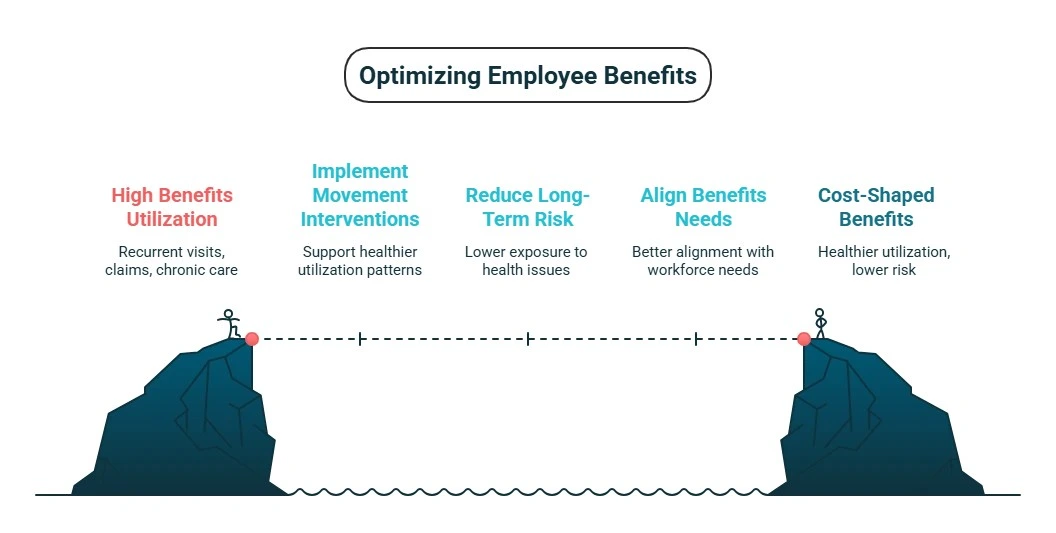
Sedentary work is one of the few health risks created almost entirely by work itself. That also makes it one of the few areas where HR has meaningful influence early on.
By addressing inactivity before it manifests as a medical or productivity issue, organisations can support healthier employees while optimising the long-term value of their benefits investment.
Prevention is not about doing more. It is about designing work that asks the body to do less harm. Begin building a more active and healthier workforce!
For more quick tips for the next month, subscribe to us here.
HealthMetrics is a unified digital TPA platform designed to streamline healthcare administration for insurers and corporates across Southeast Asia. It connects you to a regional healthcare network, automates claims and benefit management, and delivers real-time insights to optimise cost, care, and experience.
Whether you’re managing members at scale or navigating complex cross-border care, HealthMetrics empowers you with smarter tools and a seamless ecosystem.
Explore the HealthMetrics Platform or connect with our team to learn how we’re transforming healthcare access.
48 hours saved in benefit reimbursement.
HealthMetrics’ data-driven approach has been able to accelerate the processing of employee's health benefits significantly.
Read study >
85% reduction in administrative task
Companies can reduce up to 85% of time spent on HR administrative task and this frees up time for HR on more important tasks.
Read study >
Our pricing plans vary in terms of the features and services that are included, so you can select the one that offers the right mix of benefits for your specific requirements. Whether you are a small business owner, a freelancer, or a larger organisation, we have a pricing plan that is tailored to your needs.
You can view the details of each pricing plan on our website, and our customer support team is always available to answer any questions you may have and help you choose the right one for you.
Reach out to our 24/7 customer support through multiple channels.